A Young Collector
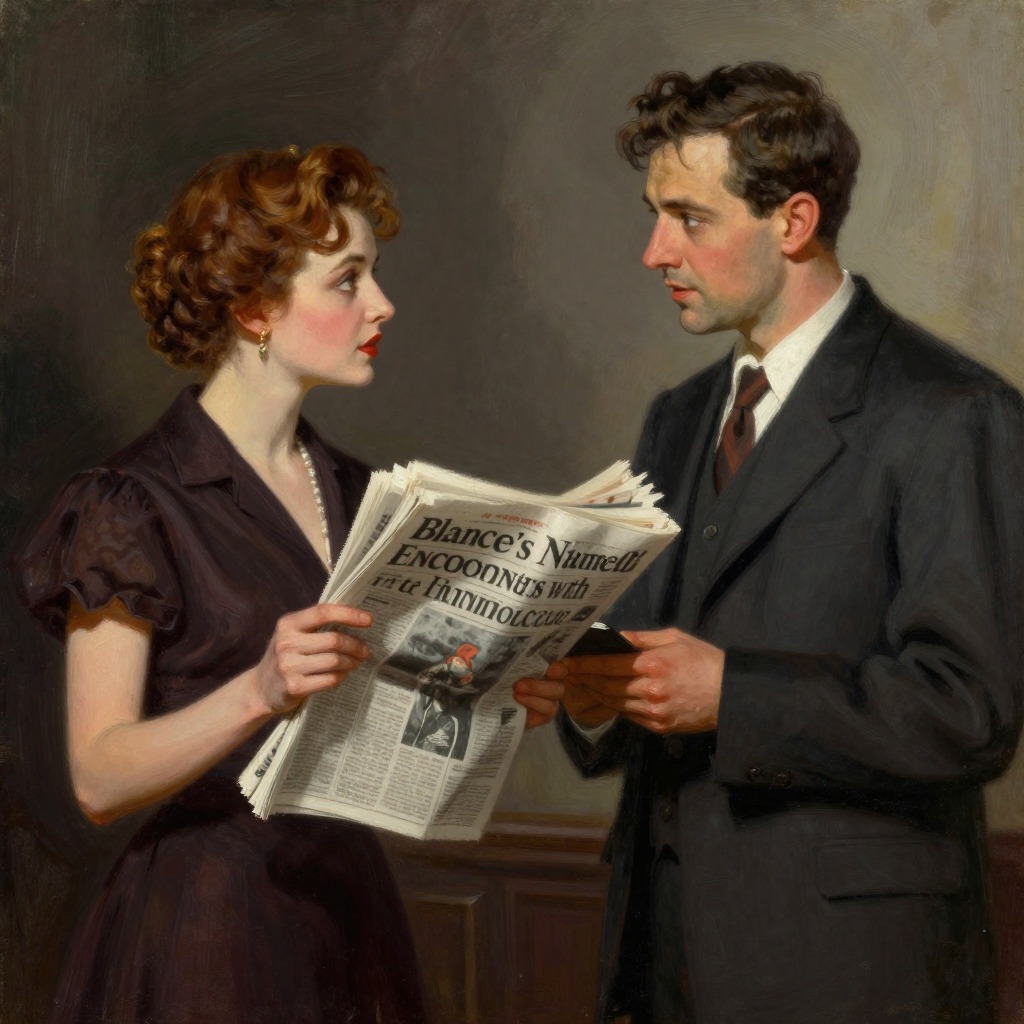
A Young Collector appears only once in the play, during the late afternoon of Scene Five, when he arrives at the Kowalski apartment to collect money for The Evening Star. He is a shy, polite young man who initially refuses Blanche's offer of a drink because he cannot drink on the job. Blanche, left alone after Stella has gone out with Stanley, engages him in a flirtatious conversation that quickly becomes charged with her characteristic blend of romantic fantasy and sexual manipulation. She comments on his youth, comparing him to "a young Prince out of the Arabian Nights," and after a brief, hesitant exchange, she crosses to him and kisses him "softly and sweetly on your mouth." Immediately afterward she sends him away, saying, "It would be nice to keep you, but I've got to be good—and keep my hands off children." The Young Collector leaves with a dazed look, and moments later Mitch arrives with roses, marking the transition from one romantic prospect to another.
Symbolic Role and Thematic Resonance
The Young Collector functions as a living emblem of the pattern Blanche later confesses to Mitch: after the death of her young husband Allan Grey, she sought "intimacies with strangers" to fill her empty heart, driven by "panic, just panic." The Collector's youth—he is described as a "young man" and Blanche calls him a "child"—directly echoes the seventeen-year-old boy with whom she became involved in Laurel, an affair that led to her dismissal from her teaching position. In her confession to Mitch, Blanche admits that after Allan's suicide she turned to "a seventeen-year-old boy" and that "somebody wrote the superintendent about it—'This woman is morally unfit for her position!'" The Young Collector thus serves as a dramatic shorthand for the cycle of desire, shame, and self-destruction that defines Blanche's life after Allan's death. His presence in the play also reinforces the motif of youth and age that runs throughout A Streetcar Named Desire: Blanche, who lies about her age and fears the loss of her beauty, is drawn to the Collector's innocence and vitality even as she recognizes the impropriety of her attraction. The kiss she gives him is a fleeting, almost predatory act of appropriation, a moment in which she attempts to capture the youth and purity she feels she has lost. His silent, bewildered departure underscores the futility of her gesture and the loneliness that awaits her after the encounter.
Connection to Blanche's Past and Future
The Young Collector is not merely a random passerby; he is a narrative echo of the traumatic events that have shaped Blanche's present. The kiss she gives him is a miniature reenactment of the pattern that led to her social ruin in Laurel, and it foreshadows the final, violent confrontation with Stanley, who will later rape her and destroy the last remnants of her fragile self-deception. The Collector's youth also contrasts sharply with the brutal masculinity of Stanley, who represents the raw, unromanticized sexual force that ultimately overwhelms Blanche. In the play's symbolic economy, the Young Collector belongs to the world of romantic illusion—the world of "magic" that Blanche tries to create with paper lanterns and soft lighting—while Stanley embodies the "realism" she dreads. The Collector's brief appearance thus encapsulates the central tension of the play: Blanche's desperate need for tenderness and her inability to find it in a world that demands either submission or destruction.